Trump Turns Up the Pressure on Iran as Economic Sanctions Go to Full Force
Trump turns up economic pressure on Iran as sanctions intensify, targeting the regime’s access to global markets and U.S. dollars.
Trump Turns Up the Pressure on Iran as Economic Sanctions Go to Full Force
Trump’s Three-Pronged Iran Strategy Intensifies as Economic Pressure Reaches Full Force
President Donald Trump is escalating pressure on Iran through military, diplomatic and economic measures, with the administration now placing its greatest emphasis on sanctions and financial restrictions.
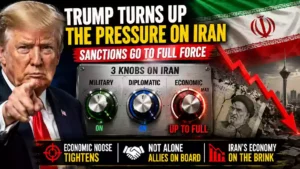
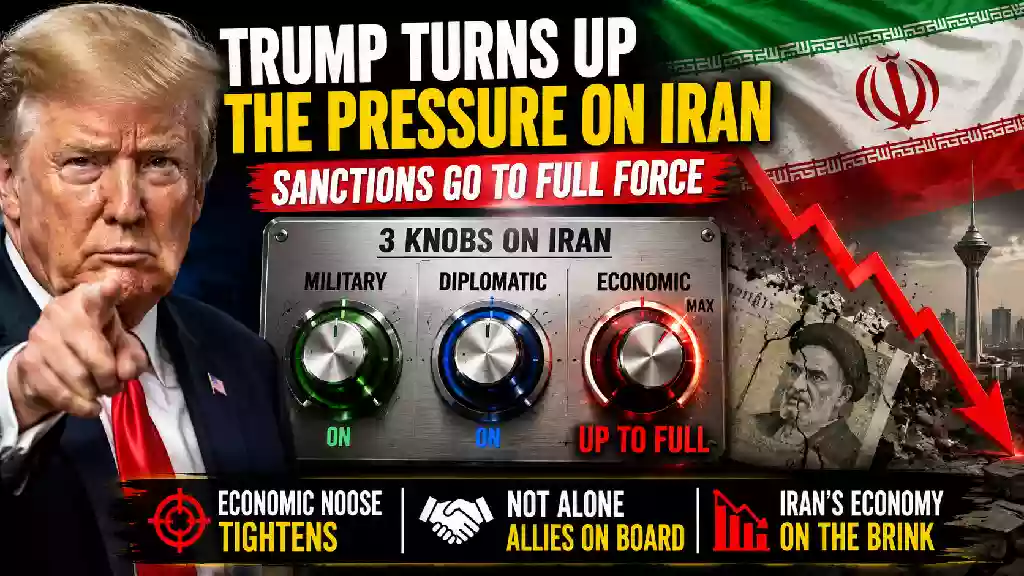
The Trump administration is intensifying its economic campaign against Iran as Washington seeks to restrict the Iranian regime’s access to the global economy and the U.S. dollar. Retired General Mark Kimmett, a former assistant secretary of state, described the approach as President Donald Trump “dialing three knobs” — military, diplomatic and economic — while turning the economic pressure “up to full.”
The strategy comes as Iran faces mounting economic difficulties, including severe inflation, a rapidly weakening currency and growing pressure on households struggling to afford basic necessities.
Trump’s Three-Front Strategy Against Iran
According to Kimmett, the administration’s Iran strategy involves three major areas: military pressure, diplomatic efforts and economic sanctions.
While all three remain important, the economic component has become a central focus. Washington is seeking to isolate Iran from the international financial system while restricting its ability to access U.S. dollars, either directly or through third parties.
That approach includes secondary sanctions, which can target organizations, companies or other countries that help Iran maintain access to international markets.
Kimmett described the effort as an “economic D-Day,” stressing that the United States is working with international allies to enforce the sanctions campaign. The comparison highlights Washington’s reliance on cooperation from other countries rather than attempting to impose the economic measures alone.
Secondary Sanctions Could Broaden the Economic Squeeze
The administration’s strategy could extend beyond Iran itself.
According to the discussion, Washington is also prepared to target third-party facilitators that assist Iran economically. That could increase pressure on businesses and other entities that continue conducting transactions involving the Iranian regime.
The goal is to make it increasingly difficult for Iran to bypass American sanctions through international financial networks.
However, expanding sanctions creates another challenge: the potential impact on ordinary Iranian citizens. Kimmett acknowledged that economic restrictions can produce a “backwash” effect, meaning that sanctions intended to pressure a government can also cause hardship for the population.
Iran’s Economic Crisis Deepens
The source describes Iran’s economy as being close to complete collapse, citing an exchange rate of approximately 2 million Iranian rial to one U.S. dollar and inflation approaching 90 percent.
The economic consequences are increasingly visible in everyday life. Although grocery stores may still have supplies, many Iranian families reportedly struggle to afford basic goods.
Unemployment is also rising, while workers are earning money that has lost substantial purchasing power. As the value of the Iranian rial declines, essential items such as food and medicine become increasingly difficult for families to afford.
Sanctions Could Come With a Human Cost
The central dilemma facing Washington is how to put maximum pressure on Iran’s leadership without creating overwhelming suffering among the Iranian population.
Economic sanctions can weaken a government’s financial resources, but they can also affect businesses, workers and families. The source acknowledges that the Iranian people are likely to feel some of the economic consequences as the sanctions campaign intensifies.
That makes the administration’s approach a difficult balancing act: squeeze the regime while attempting to limit the damage experienced by ordinary citizens.
Historical Lessons Raise Concerns
Kimmett also drew a comparison between Iran’s economic situation and Weimar Germany after World War I, when extreme inflation devastated the German economy.
The historical comparison serves as a warning about the potential political consequences of economic collapse. Kimmett argued that Washington must be careful not to push the Iranian population into such severe hardship that the economic pressure ultimately produces an unintended political outcome.
He specifically warned that excessive pressure could potentially create conditions in which the Iranian Revolutionary Guards Corps gains greater influence and could even position itself as an ally of the Iranian people.
Trump Faces a High-Stakes Test in Iran
The Trump administration’s intensified Iran strategy represents a major test of whether economic pressure can force changes in Tehran’s behavior.
With economic sanctions, secondary sanctions, diplomatic pressure and military options all part of the broader strategy, Washington is attempting to increase pressure on the Iranian regime from multiple directions.
But the consequences could extend far beyond Iran’s leadership. As inflation rises and the value of the rial falls, ordinary Iranians may continue to face mounting financial hardship.
The challenge for Trump will be determining how far the United States can push its economic campaign without producing consequences that undermine its broader objectives. The outcome could shape not only Iran’s future, but also the wider balance of power across the Middle East.
#Trump #Iran #IranSanctions #EconomicSanctions #SecondarySanctions #IranEconomy #IranCrisis #TrumpAdministration #MiddleEast #USForeignPolicy